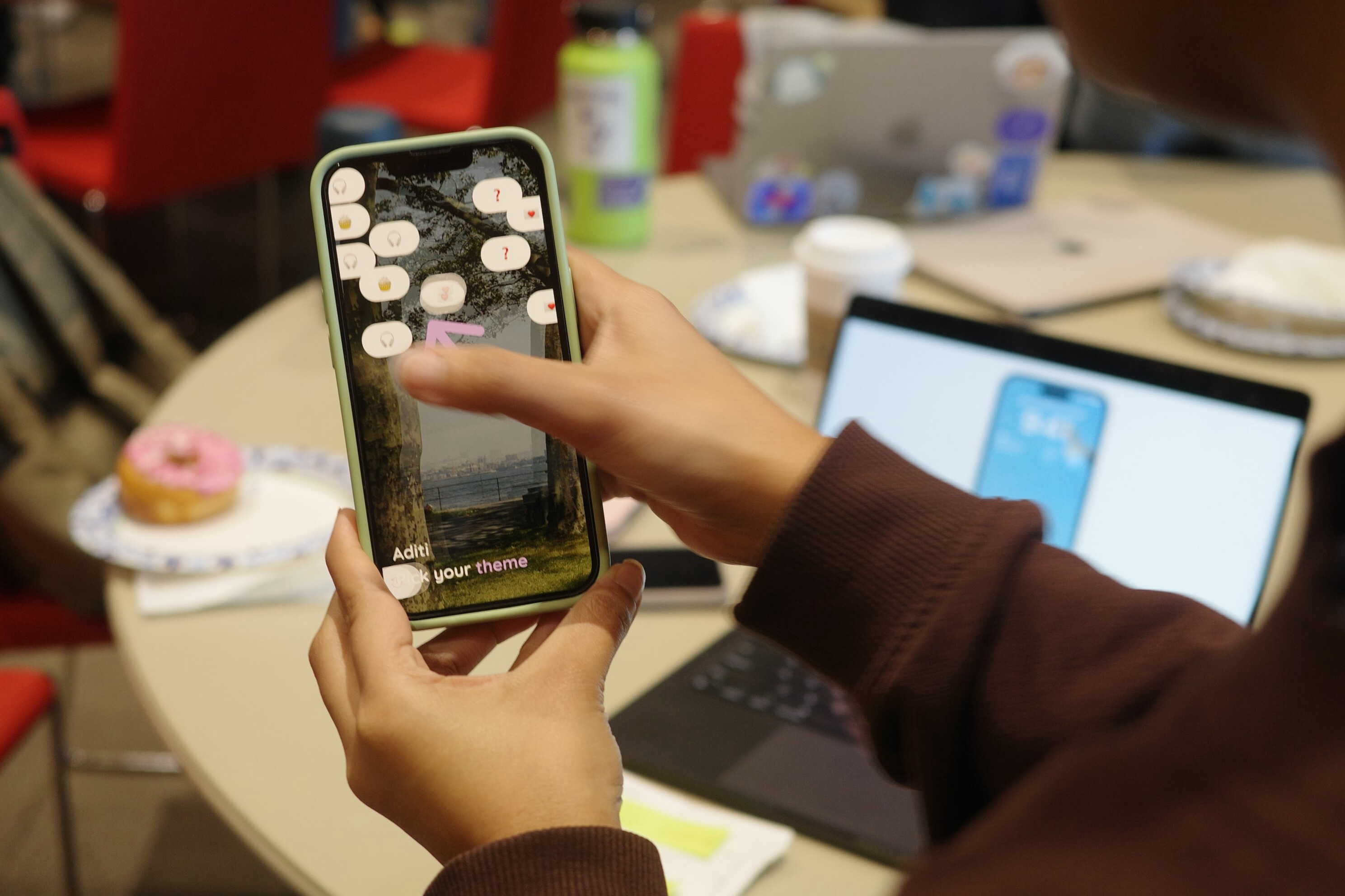
Premise
Commutes follow the same routes, optimized for speed. People pass potential detours—parks, cafes, trails—but rarely deviate. Not because options don’t exist, but because choosing where to go and what to do adds cognitive load to an already routine decision.
What if small nudges during movement you’re already doing could shift behavior from pure efficiency to occasional unwinding experiences?
Detour explores whether lightweight interventions can make urban exploration feel less like a separate activity requiring planning and more like an option embedded in existing routines.
uh-oh
sorry for the inconvenience,
this was supposed to load by now...
Outcome
The accompanying bodystorming and persona study validate the core hypothesis: that efficiency and exploration can coexist. By contrasting a standard commute with a Detour-enabled journey, the narrative highlights how “Artifact” collection shifts attention from the destination to the immediate environment. This habit is further reinforced through collaborative trails, where shared wayfinding creates enhanced scores—transforming a solitary walk into a collective ritual.
Shifting focus from the destination to the journey.

It feels like a tool that brings to life a thought many people have had at least once: 'What if we could feel the joy of traveling in our everyday lives?'
"Well reasoned and helpful to achieve the problem of the user in trying to spice up navigation in daily life.
"Interaction Model
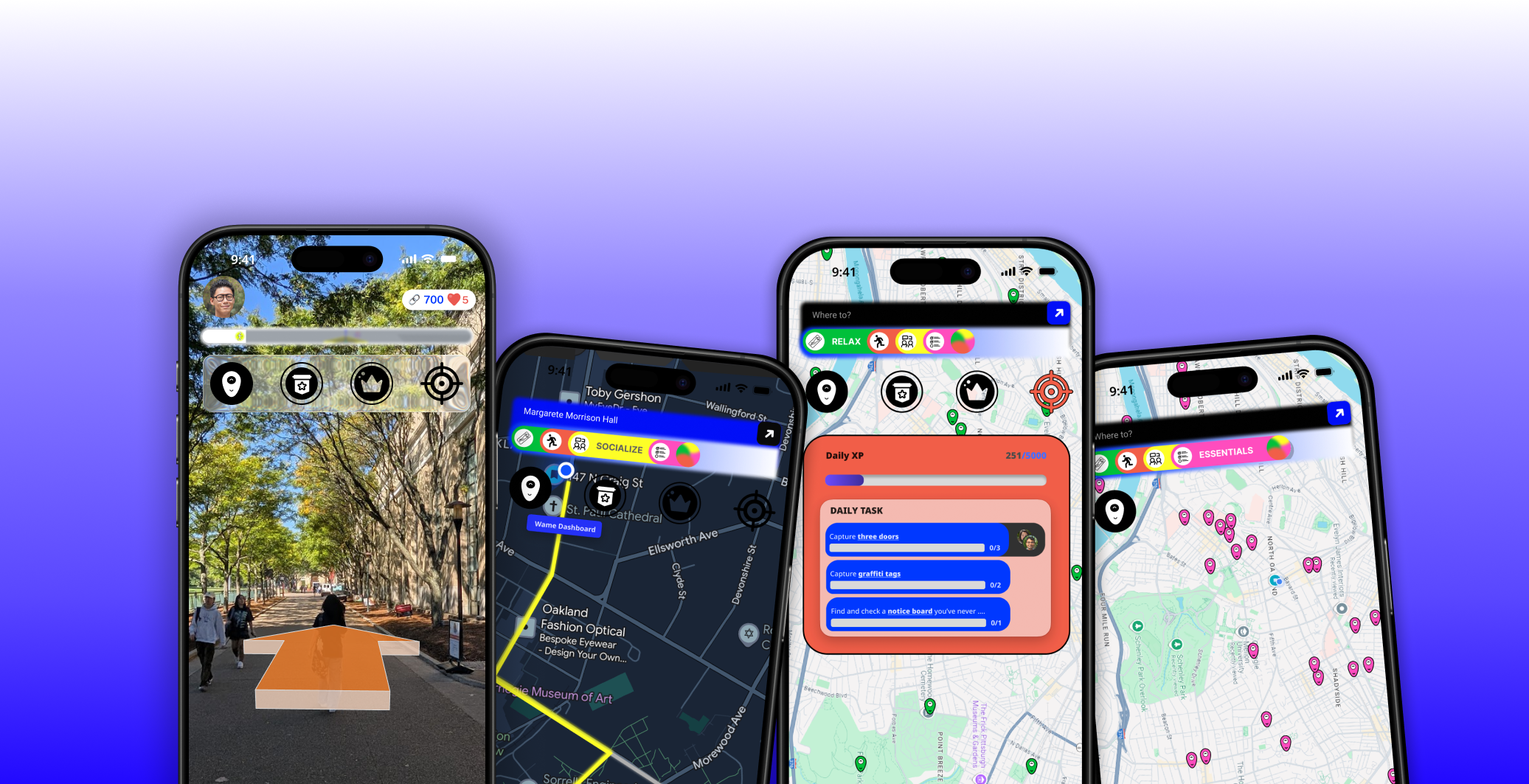
The prototype build demonstrates the core loop in real-time: filtering intent, engaging with quests, and navigating generative paths.
Approach
Looking at prior art which were successful to integrate themselves into users’ daily routines — to understand what makes behavior change stick.
Three patterns emerged:
at decision pointsBuilding habits through
consistent triggers & rewardsGiving users reasons that
feel personally meaningful
How do these apply to making detours feel natural instead of effortful?
Design direction: Lower the friction of choosing (daily quests, limited options), create habit loops through small wins and progression, frame detours as opportunities tied to user intent—relaxation, play, social connection, necessities.
Implementation
Translating the prior art principles into a product system meant limiting variables at every decision point.
- 4intent categories to choose a detour from.
- 3daily prompts nudging to capture and be present.
- 2detours per day to promote habits.
- 1trail to help associate experiences with memories.
The goal is to create just enough friction to make choosing feel manageable. Each constraint addresses a specific behavioral barrier—categories give meaning, quests build habits, limited detours reduce overwhelm, single trail maintains memories.
Deliberately small to lower the cost of saying yes.
Interaction Framework
The interaction model tries to prioritize presence over precision.
👀 Intent-Based Scoping
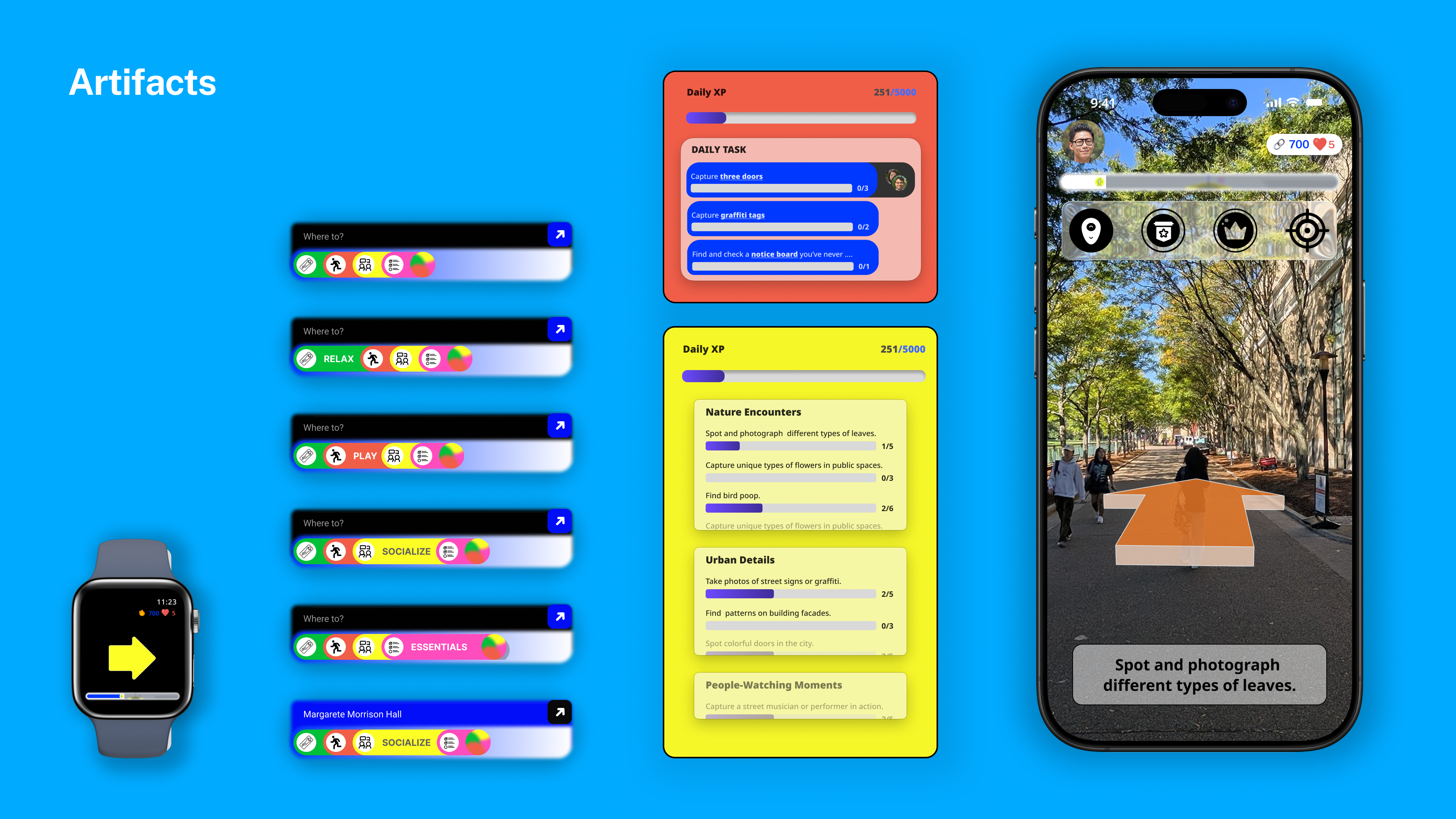
Wandering without a goal can feel aimless, but wandering with a specific destination feels like a chore. The system bridges this by filtering the map through four emotional states:
This allows the backend to generate relevant waypoints while the user feels they are simply choosing a “vibe” rather than a coordinate.
Structure enables spontaneity by narrowing the paradox of choice.
🧭 Heads-Up Navigation
Standard turn-by-turn directions optimize for certainty but demand constant screen attention. This “loose” navigation provides just enough information to keep the user oriented, shifting their primary focus from the screen back to the physical world.
Reducing the interaction cost of wayfinding to keep users present.
🎰 Gamified Observation
To break the habit of “tunnel vision” during commutes, the system interjects with Quests—prompts to find specific textures, colors, or objects (e.g., “Find bird poop,” “Capture three doors”). These act as cognitive speed bumps, forcing the user to slow down and actively scan their environment to earn Daily XP.
Validating the detour by turning observation into a quantifiable achievement.